
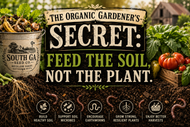
The Organic Gardener's Secret: Feed the Soil, Not the Plant
Posted by Jennifer Dixon on 1st Jun 2026
The Organic Gardener's Secret: Feed the Soil, Not the Plant
Many new gardeners focus their attention on the plants.
They buy fertilizers, search for quick fixes, and look for ways to make vegetables grow faster and larger.
But ask an experienced organic gardener what the secret is to a productive garden, and you'll often hear the same answer:
Don't feed the plant.
Feed the soil.
This simple philosophy has guided successful gardeners and farmers for generations. Long before synthetic fertilizers became common, growers understood that healthy plants begin with healthy soil.
At South GA Seed Co., we believe some of the best gardening wisdom is also the simplest.
Plants Are Only Part of the Story
When we look at a tomato plant, a bean vine, or a row of lettuce, it's easy to focus on what we can see above the ground.
But beneath the surface lies an entire world working quietly to support those plants.
Healthy soil contains:
-
Earthworms
-
Beneficial fungi
-
Microbes
-
Bacteria
-
Organic matter
-
Insects and soil organisms
Together, these living systems help plants access nutrients, retain moisture, and develop strong root systems.
The healthiest gardens often begin where we cannot see them.
Nature Builds Soil First
Walk through a forest and you'll notice something remarkable.
No one fertilizes the trees.
No one tills the ground.
No one spreads synthetic nutrients.
Yet the plants thrive.
Why?
Because nature constantly feeds the soil.
Leaves fall.
Branches decay.
Organic matter breaks down.
Microorganisms recycle nutrients and return them to the earth.
Healthy ecosystems focus on building soil, and the plants benefit as a result.
Old gardeners understood this principle well.
Why Synthetic Fertilizers Can Fall Short
Synthetic fertilizers can provide nutrients quickly, but they often focus on feeding the plant directly rather than improving the soil itself.
This can sometimes lead to:
-
Dependence on repeated applications
-
Reduced soil biology
-
Poor long-term soil structure
-
Increased nutrient leaching
Organic gardening takes a different approach.
Rather than forcing growth, organic gardeners work to create healthy soil that supports plants naturally year after year.
The goal is long-term fertility rather than short-term results.
Compost Is Nature's Fertilizer
One of the best ways to feed the soil is through compost.
Compost adds:
-
Organic matter
-
Beneficial microorganisms
-
Slow-release nutrients
-
Improved moisture retention
Many gardeners refer to compost as "black gold" for good reason.
Kitchen scraps, leaves, grass clippings, and garden waste can all be transformed into a rich soil amendment that helps feed the entire ecosystem beneath your plants.
Mulch Feeds the Soil Too
Older Southern gardeners rarely left soil exposed.
They covered it with:
-
Straw
-
Leaves
-
Grass clippings
-
Pine needles
-
Compost
As these materials break down, they feed soil organisms and improve fertility naturally.
Mulch also helps:
-
Retain moisture
-
Reduce weeds
-
Moderate soil temperature
-
Protect beneficial microbes
In many ways, mulch acts as a slow and steady food source for the soil.
Healthy Soil Creates Resilient Plants
Plants grown in healthy soil often develop:
-
Stronger root systems
-
Better drought tolerance
-
Improved nutrient uptake
-
Greater resistance to stress
A thriving soil ecosystem creates conditions where plants can reach their full potential without relying heavily on outside inputs.
The stronger the foundation, the stronger the garden.
Organic Gardens Improve Over Time
One of the most rewarding aspects of organic gardening is that the benefits compound.
As compost, mulch, and organic matter continue building soil health, many gardens become more productive year after year.
Earthworm populations increase.
Microbial life expands.
Moisture retention improves.
Soil structure becomes richer and more fertile.
Instead of depleting the land, organic practices help restore it.
The Secret Beneath Every Great Garden
The most productive gardens are rarely built overnight.
They are built season by season, as gardeners invest in the life beneath their feet.
Old farmers and gardeners understood something that remains true today:
Healthy soil grows healthy plants.
At South GA Seed Co., we believe feeding the soil is one of the most important investments a gardener can make. Because when the soil thrives, everything above it has the opportunity to thrive as well.
To order seeds Click Here
Related Gardening Guides
- Why Earthworms Are Every Gardener's Best Friend
- Top Organic Soil Amendments for a Thriving Garden
- Why Organic Gardens Need Less Water
- Why Old Gardens Smelled Different
- The Forgotten Vegetables Making a Comeback in Southern Gardens
- Best Tomatoes for Humid Southern Summers | Heirloom Varieties for Georgia Gardens