
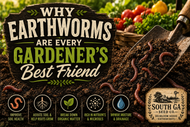
Why Earthworms Are Every Gardener's Best Friend
Posted by Jennifer Dixon on 2nd Jun 2026
Why Earthworms Are Every Gardener's Best Friend
If you ask a seasoned gardener how to tell whether soil is healthy, they may not talk about fertilizer, pH levels, or expensive soil tests.
Instead, they might simply dig a small hole and look for earthworms.
For generations, earthworms have been considered one of nature's greatest indicators of healthy soil. Long before modern gardening products filled store shelves, farmers and gardeners understood that where earthworms thrived, plants often did too.
At South GA Seed Co., we believe some of the best workers in the garden spend their entire lives underground.
Nature's Original Soil Builders
Earthworms spend their days doing work that gardeners would gladly pay for.
As they move through the soil, they:
-
Aerate the ground
-
Improve drainage
-
Break down organic matter
-
Mix nutrients throughout the soil
-
Create pathways for plant roots
Their tunnels allow air, water, and nutrients to move more freely beneath the surface.
In many ways, earthworms act as tiny natural tillers, continuously improving soil structure without disturbing the garden.
Earthworms Help Feed Your Plants
One of the most valuable things earthworms produce is their castings.
Earthworm castings are simply digested organic matter, but they are incredibly rich in nutrients and beneficial microbes.
These castings contain:
-
Nitrogen
-
Phosphorus
-
Potassium
-
Trace minerals
-
Beneficial microorganisms
Unlike synthetic fertilizers that often deliver nutrients quickly, worm castings provide a slow, steady source of fertility that supports long-term soil health.
Many gardeners consider worm castings one of the finest natural fertilizers available.
Healthy Soil Means More Earthworms
Earthworms thrive in environments rich in organic matter.
They love:
-
Compost
-
Mulch
-
Decaying leaves
-
Grass clippings
-
Garden residue
This is one reason organic gardens often develop larger earthworm populations over time.
When gardeners feed the soil with compost and organic matter, they are also feeding the earthworms that help maintain that soil.
The relationship benefits everyone involved.
Earthworms Improve Water Retention
Southern gardeners know how valuable moisture can be during hot summer months.
Earthworm tunnels help water move deeper into the soil where plant roots can access it more effectively.
At the same time, healthy worm populations contribute to improved soil structure, allowing the soil to hold moisture longer between rains.
The result is often:
-
Less runoff
-
Better drainage
-
Improved drought resistance
-
Stronger root systems
Healthy soil acts like a sponge, and earthworms help build that sponge.
Earthworms Support Soil Biology
A thriving garden is full of life that most people never see.
Healthy soil contains:
-
Fungi
-
Bacteria
-
Microbes
-
Insects
-
Earthworms
Together, these organisms form a complex living system often referred to as the soil food web.
Earthworms help support this system by breaking down organic matter and distributing beneficial microbes throughout the soil.
The more active the soil ecosystem becomes, the more productive the garden often becomes as well.
Why Old Gardens Had So Many Earthworms
Many older Southern gardens were managed differently than modern landscapes.
Gardeners routinely added:
-
Compost
-
Animal manure
-
Straw
-
Leaves
-
Garden waste
Very little organic material went to waste.
Everything eventually returned to the soil.
These practices created ideal conditions for earthworms to flourish.
As worm populations increased, soil fertility improved naturally year after year.
The garden became richer with every season.
How to Attract More Earthworms
Fortunately, encouraging earthworms is simple.
Start by feeding the soil.
Add:
-
Compost
-
Mulch
-
Leaf mold
-
Aged manure
-
Organic matter
Avoid excessive tilling whenever possible, as frequent disturbance can damage worm populations and disrupt soil structure.
The more you mimic nature, the more earthworms tend to thrive.
Tiny Workers, Big Results
Earthworms may not receive much attention compared to flowers, vegetables, or pollinators, but their impact on the garden is remarkable.
Every tunnel they create improves the soil.
Every casting they leave behind enriches the ground.
Every day they spend beneath the surface helps build a healthier foundation for the plants above.
At South GA Seed Co., we believe some of the most important work in the garden happens where few people ever look.
And that's exactly why earthworms deserve to be called every gardener's best friend.
To order Click Here