
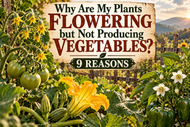
Why Are My Plants Flowering but Not Producing Vegetables? 9 Reasons
Posted by Jennifer Dixon on 4th Oct 2026
There is something frustrating about seeing a vegetable plant covered in beautiful flowers and thinking, “Well, where are the vegetables?”
You did everything right.
The plant is green.
It's growing.
It's flowering.
And yet... nothing.
No tomatoes.
No peppers.
No squash.
No cucumbers.
Just flowers.
If you've ever stood in your garden wondering what on earth is going on, you're certainly not alone.
This is one of the most common questions gardeners have, especially during periods of hot weather.
And the answer isn't always as simple as saying, “You need more bees.”
Sometimes the problem is pollination.
Sometimes it's the heat.
Sometimes it's watering.
Sometimes the plant has too much nitrogen.
And sometimes the plant is actually doing exactly what it is supposed to do—you just haven't reached the right stage of growth yet.
Let's look at the most common reasons your plants may be flowering but not producing vegetables.
1. The Flowers Aren't Being Pollinated
Let's start with one of the most common reasons.
Flowers have a job to do.
For a fruit to develop, the flower generally needs successful pollination first.
This is particularly important with crops such as:
• Squash
• Cucumbers
• Pumpkins
• Melons
• Watermelons
These plants produce separate male and female flowers.
The male flower provides the pollen, while the female flower contains the tiny developing fruit at its base.
For normal fruit development, pollen needs to make its way from the male flower to the female flower.
Bees and other pollinating insects do much of this work for us.
If that transfer doesn't happen, you'll get flowers without vegetables.
And sometimes you'll see a tiny squash or cucumber begin to form, only for it to shrivel and fall off.
That can also be a sign of incomplete pollination.
2. It's Simply Too Hot
This is a big one for Southern gardeners.
And if you've gardened in Georgia for any length of time, you already know how quickly summer heat can change a garden.
Your plant may look perfectly healthy.
It may have plenty of flowers.
But extreme heat can interfere with the entire process of turning those flowers into fruit.
Hot weather can cause flowers to drop before they have a chance to develop, and high temperatures can interfere with pollen and fruit set in several common vegetable crops.
This is one reason a tomato plant may produce beautifully in the spring, slow down dramatically during the hottest part of summer, and then begin producing again when temperatures become more favorable.
Sometimes the plant isn't failing.
It's simply waiting for better conditions.
3. Your Plant Has Too Much Nitrogen
This one catches a lot of gardeners by surprise.
You see a huge, beautiful plant and think you're doing everything right.
The leaves are enormous.
The plant is deep green.
It's growing like crazy.
But there are very few vegetables.
Sometimes the problem is too much nitrogen.
Nitrogen encourages leafy green growth.
That's useful—but a vegetable plant needs to balance vegetative growth with flowering and fruit production.
Too much nitrogen can result in a beautiful plant that seems determined to produce leaves instead of vegetables.
This is why more fertilizer isn't necessarily better.
A garden isn't a race to see how big we can make the plant.
We're trying to grow a healthy plant that produces.
4. The Plant Is Stressed From Inconsistent Watering
Water is another big piece of the puzzle.
A plant that's flowering and producing fruit is using a lot of energy.
If the soil swings repeatedly from very dry to very wet, the plant can become stressed.
This is especially important during periods of heat.
Drought stress can contribute to blossom drop and poor fruit development.
But watering too much isn't the answer either.
Roots need oxygen.
Constantly saturated soil can create its own problems.
The goal isn't to keep the soil swampy.
It's to provide steady moisture without keeping the roots waterlogged.
A good layer of mulch can also help keep soil moisture more consistent during hot weather.
5. Your Plant Isn't Getting Enough Sun
Vegetables need sunlight.
A plant can look perfectly healthy while still not receiving enough light to produce well.
If your garden has become shaded by:
• Trees
• Fences
• Buildings
• Taller crops
• New structures
you may notice reduced flowering or fruit production.
Most fruit-producing vegetable plants perform best with plenty of direct sunlight.
This is particularly important for tomatoes, peppers, cucumbers, squash, beans, and melons.
If your plant is growing leaves but seems reluctant to produce, take a look at how much direct sunlight it receives each day.
Sometimes the problem isn't the soil.
It's the tree next door.
6. You're Seeing Male Flowers Instead of Female Flowers
This one is especially important with squash, cucumbers, pumpkins, and melons.
If you've ever looked at your squash plant and thought:
“Why in the world does this thing have a hundred flowers and not one squash?”
Take a closer look.
Male and female flowers look different.
The female flower has a small swollen area directly behind the flower.
That little swelling is the beginning of the fruit.
A male flower has a straight stem behind it.
If you have lots of male flowers but very few female flowers, you won't get many vegetables.
And this can happen naturally, particularly early in the life of the plant.
The plant may produce mostly male flowers at first and begin producing more female flowers as it matures.
So don't panic if your squash produces a bunch of male flowers first.
Give it some time.
Your female flowers may be coming.
7. There Aren't Enough Pollinators Visiting the Garden
Sometimes the flowers are there.
The female flowers are there.
The weather is reasonable.
But the pollinators simply aren't visiting often enough.
Squash and cucumber flowers have a relatively short window in which pollination needs to happen.
That makes pollinator activity especially important.
Rainy, windy, cold, or otherwise unfavorable weather can reduce pollinator activity.
That's one reason I love having flowers around the vegetable garden.
A garden filled with flowering plants gives pollinators another reason to stick around.
And here's something else worth remembering:
Not every insect you see crawling around inside a flower is necessarily a pest.
Bees, butterflies, native pollinators, and other beneficial insects are part of the garden ecosystem.
8. The Plant Is Still Too Young
Sometimes the answer is simply:
Give it time.
A young plant may begin flowering before it is mature enough to produce a substantial crop.
This is particularly noticeable when you're growing from seed.
The plant is essentially saying:
“Look! I'm growing up!”
But that doesn't necessarily mean it's ready to give you a basket full of vegetables.
Young plants may need time to establish their roots, develop foliage, and build enough energy to support fruit production.
So don't immediately assume something is wrong because the first few flowers don't become vegetables.
Watch the plant.
If it's healthy and continuing to grow, more flowers will often follow.
9. Disease, Pests, or General Plant Stress
Finally, take a good look at the entire plant.
Is something chewing on the leaves?
Are the leaves yellowing?
Are the stems damaged?
Does the plant wilt repeatedly?
Are the flowers drying up unusually fast?
Does the soil stay wet?
Is the plant struggling to grow?
A plant under significant stress may not have enough resources to produce a good crop.
This is one reason I don't like looking at a single symptom in isolation.
A plant that isn't producing isn't necessarily suffering from one specific problem.
Look at the whole garden.
Look at the leaves.
Look at the roots if necessary.
Look at the soil.
Look at the weather.
Look for insects.
And think about what has changed recently.
Why Are My Tomato Plants Flowering but Not Producing Tomatoes?
Tomatoes are a little different from squash and cucumbers.
Tomatoes don't require bees to transfer pollen between separate male and female flowers in the same way cucurbits do.
Their flowers contain both reproductive parts, and movement of the flower can help release pollen.
However, temperature still matters.
Very hot conditions can interfere with tomato fruit set.
So if your tomato plants are covered in flowers during a Georgia heat wave but aren't producing tomatoes, don't immediately assume you need to add fertilizer.
Look at the temperatures first.
Sometimes the plant simply needs the weather to moderate.
And that's one of those gardening lessons we learn over and over:
You can't control the weather.
Why Are My Squash Plants Flowering but Not Producing Squash?
This is probably one of the most frustrating examples.
You walk outside and see flowers everywhere.
But no squash.
First, check whether you're seeing male or female flowers.
Look behind the flower.
If there is a tiny swollen squash-shaped structure, that's a female flower.
If there's only a straight stem, it's a male flower.
Then look for pollinators.
Squash flowers depend heavily on insect pollination, and the flowers have a limited window for successful pollination.
If a female flower opens and doesn't get adequately pollinated, the tiny squash may begin growing and then shrivel.
It can look like the plant has some mysterious disease.
Often, it's simply a pollination problem.
Why Are My Pepper Plants Flowering but Not Producing Peppers?
Peppers can be frustrating too.
You may have a beautiful pepper plant covered in blossoms and wonder where the peppers are.
Temperature stress can be part of the problem.
Very hot conditions can interfere with flower development and fruit set in peppers and other vegetables.
If your plants are otherwise healthy, don't give up after one bad stretch of weather.
Keep the plants healthy and properly watered and watch what happens when temperatures become more favorable.
Sometimes the best gardening solution is patience.
How to Help Your Plants Produce More Vegetables
If your plants are flowering but not producing, don't immediately start throwing products at the problem.
Instead, go down the list.
Check the weather.
Check the soil moisture.
Look at the amount of sunlight.
Look at the leaves.
Look at the flowers.
Look for pollinators.
Check whether you're seeing male or female flowers.
Think about how much fertilizer you've applied.
And make sure the plant is actually mature enough to produce.
Good gardening is often less about adding something and more about figuring out what the plant is already telling you.
Ways to Encourage Better Pollination
There are several simple things you can do to make your garden more welcoming to pollinators.
Plant flowers near your vegetables.
Avoid unnecessary insecticide use, especially when plants are blooming.
Provide a variety of flowering plants.
Allow some beneficial flowering plants to remain near the garden.
And don't assume every insect in your garden is a pest.
Bees, butterflies, native pollinators, and other beneficial insects are part of the garden ecosystem.
For crops that require insect pollination, protecting those pollinators can directly benefit your harvest.
Can You Hand-Pollinate Your Vegetables?
Yes.
If you're growing squash, cucumbers, pumpkins, or melons and pollination seems to be the problem, hand-pollination can sometimes help.
The basic idea is simple.
You transfer pollen from a male flower to a female flower yourself.
The easiest way to identify the female flower is to look for the tiny immature fruit directly behind the petals.
For squash and related crops, this can be especially useful when there are few pollinators active in the garden.
A small, clean paintbrush works well for transferring pollen.
The best time is generally in the morning while the flowers are open.
But before reaching for a paintbrush, take a moment to look around your garden.
If bees are already working the flowers, you may not need to interfere at all.
Don't Forget the Soil
Healthy plants start with healthy soil.
If your plants repeatedly struggle to produce, it's worth looking beyond the flowers.
Is your soil compacted?
Does it drain properly?
Does it hold moisture?
Have you added organic matter?
Have you had the soil tested?
Good soil doesn't guarantee a perfect harvest, but poor soil can certainly make gardening harder.
And remember that fertilizer isn't a substitute for good soil structure.
Sometimes the best thing you can give your garden isn't another bottle or bag.
It's compost.
It's organic matter.
It's mulch.
It's time.
From Jen's Garden
I've learned that one of the hardest parts of gardening is accepting that sometimes the plant isn't doing anything wrong.
We gardeners like to fix things.
We see a problem and immediately think:
“What do I need to add?”
More fertilizer?
More water?
Another spray?
Something must be missing.
But sometimes the plant is simply responding to the weather.
I've watched plants flower beautifully and then refuse to set fruit during stretches of brutal Southern heat.
And then the weather changes.
The nights cool down.
The rain comes.
The bees become active again.
And suddenly the plant starts producing.
That's one of the reasons I try not to panic over one bad week in the garden.
Plants are living things.
They're responding to temperature, water, sunlight, insects, soil, and everything else happening around them.
Sometimes the best thing we can do is pay attention and give them the conditions they need.
And then wait.
That's hard for gardeners.
We want tomatoes now.
But gardening has a way of teaching patience whether we like it or not.
Quick Checklist: Flowers but No Vegetables?
If your plant is flowering but not producing, ask yourself:
• Is the plant getting enough sunlight?
• Is the weather unusually hot?
• Are temperatures staying unusually high?
• Is the soil consistently moist without being waterlogged?
• Are pollinators visiting?
• If it's squash or cucumber, are there female flowers?
• Is the plant producing mostly male flowers?
• Have I applied too much nitrogen?
• Is the plant old enough to produce?
• Are insects or disease stressing the plant?
• Has anything recently changed in the garden?
• Could the plant simply need more time?
Final Thoughts
When your vegetable plants are flowering but not producing, don't give up on them.
Flowers are actually a good sign.
They tell you that your plant has reached the stage where it is trying to reproduce.
Now we just need to figure out what's preventing the next step.
Sometimes it's pollination.
Sometimes it's heat.
Sometimes it's water.
Sometimes it's too much nitrogen.
Sometimes it's stress.
And sometimes, honestly, it's just patience.
The good news is that many of these problems can be corrected—or simply allowed to pass when conditions improve.
So the next time you walk into your garden and see flowers but no vegetables, don't pull the plant out.
Take a closer look.
The answer may be sitting right there in the flowers.
To order seed Click Here
Related Gardening Guides
• Why Is My Vegetable Garden Not Producing? 10 Common Reasons and How to Fix Them
• Best Tomatoes for Humid Southern Summers: Heirloom Varieties for Georgia Gardens
• How to Prevent Powdery Mildew on Squash Family Plants
• The Lost Art of Seed Saving in Southern Gardens
• Wildflowers to Plant in Fall: Beautiful Flowers for a Spring Garden