
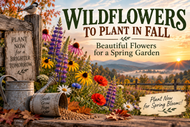
Wildflowers to Plant in Fall: Beautiful Flowers for a Spring Garden
Posted by Jennifer Dixon on 4th Sep 2026
WILDFLOWERS TO PLANT IN FALL: BEAUTIFUL FLOWERS FOR A SPRING GARDEN
When most people think about planting flowers, they think about spring.
But there is something wonderfully backwards about gardening sometimes. While the garden is slowing down for the year, fall can actually be one of the best times to put wildflower seeds into the ground.
Instead of waiting until spring and trying to do everything at once, you can plant certain wildflowers in late fall and let nature take care of part of the process over winter.
Come spring, those tiny seeds that seemed to be doing absolutely nothing can suddenly wake up and begin growing.
For gardeners here in Georgia and across the South, fall can be an especially useful time to plant wildflowers. Many wildflower species naturally drop their seeds at the end of the growing season, allowing them to experience the cool temperatures of winter before spring arrives.
And there is something pretty special about planting a little patch of wildflowers in the fall and then forgetting about it for a while.
Then spring comes along and surprises you.
WHY PLANT WILDFLOWERS IN FALL?
One of the biggest reasons to plant wildflowers in fall is simple: you are working with nature instead of against it.
In nature, many wildflowers finish blooming, produce seed, and drop those seeds onto the ground in late summer or fall. The seeds remain in the soil or on the soil surface through winter and begin growing when conditions are right in spring.
Some species benefit from a period of cold, moist conditions called cold stratification. This helps break seed dormancy and prepares the seed for germination.
Fall planting can essentially allow winter to do some of that work for you.
UGA Extension recommends late fall and winter sowing for many wildflowers in Georgia as soil temperatures decline. The exact timing will depend on where you live and the species you are planting.
That last part is important.
Not every flower seed should be planted in fall.
But many cool-season wildflowers and hardy perennial flowers can be excellent candidates.
WHEN SHOULD YOU PLANT WILDFLOWER SEEDS IN FALL?
This is one of those questions where there isn't one perfect date for everyone.
Georgia stretches from the mountains to the coast, and fall arrives differently across the state.
Northern Georgia will cool down earlier than South Georgia. Here in the South, we may still be dealing with warm soil and summer-like temperatures long after the calendar says fall.
For many wildflowers, the goal is to plant late enough that the seeds won't immediately germinate during a warm spell, but early enough that they have a chance to settle into the soil.
Late fall into winter is often a better window than early fall for many wildflower plantings.
A good rule is to pay attention to the weather rather than simply the calendar.
Once the heat of summer has truly broken and the soil is beginning to cool consistently, it may be time to start thinking about your fall wildflower planting.
UGA Extension guidance also emphasizes choosing wildflowers or mixes that are adapted to your region. A mixture that performs beautifully somewhere else in the country may not be suited to Georgia's heat and humidity.
WILDFLOWERS YOU CAN PLANT IN FALL
There are many different flowers that can be included in a fall wildflower garden.
Some are native perennials, some are annuals, and some are old-fashioned garden flowers that have been grown for generations.
Here are some beautiful choices to consider.
BLACK-EYED SUSAN
Black-Eyed Susan is one of those flowers that seems like it belongs in a wildflower meadow.
The golden-yellow petals surrounding the dark center bring a cheerful splash of color to the summer garden, and the flowers are attractive to bees, butterflies, and other beneficial insects.
Black-Eyed Susan is also a wonderful choice for gardeners who want something hardy and relatively easy to grow.
The seeds can be surface sown or only lightly covered because they benefit from light for germination.
Fall planting can give the seeds an opportunity to experience natural winter conditions before spring growth begins.
Black-Eyed Susan is also valuable beyond its flowers. Mature seed heads can provide food for birds later in the year.
If you want a flower that looks right at home in a cottage garden, pollinator garden, or wildflower patch, Black-Eyed Susan is hard to beat.
PURPLE CONEFLOWER
Purple Coneflower is another wonderful perennial for a natural-looking flower garden.
Its purple petals and prominent central cone make it instantly recognizable, and it is a favorite among pollinators.
Purple Coneflower is native to North America and is well suited to sunny gardens with well-drained soil.
Like many perennial wildflowers, it can benefit from being planted at the right time and given the natural seasonal conditions it expects.
The seeds should not be buried deeply. In fact, Purple Coneflower seeds are best surface sown or only lightly covered.
Once established, these plants can return year after year.
And honestly, there is something wonderful about a perennial flower that comes back every summer without needing to be replanted.
WHITE SWAN CONEFLOWER
If you love the look of Purple Coneflower but want something a little different, White Swan Coneflower is a beautiful option.
Instead of purple petals, White Swan produces elegant white flowers surrounding golden-brown centers.
It has the same natural, old-fashioned appearance that makes coneflowers such a wonderful addition to pollinator gardens and informal flower beds.
Planting perennial flowers like coneflower in the cooler months gives them time to establish before the heat of the following summer arrives.
Just remember that seeds and young plants still need appropriate moisture while they are becoming established.
RED CORN POPPY
If you want something that makes a statement, don't overlook the old-fashioned Red Corn Poppy.
Those bright scarlet flowers have been grown in gardens for generations and have a wonderful cottage-garden and wildflower-meadow appearance.
Poppies are also a good example of why planting depth matters.
Their seeds are tiny and should not be buried deeply. They need good contact with the soil surface and appropriate moisture to get started.
Fall sowing can work particularly well for certain poppies because the seeds can experience the cooler conditions of winter before emerging when temperatures become favorable.
And when those red flowers finally appear in spring, they are hard to miss.
ROCKET LARKSPUR
Larkspur is another old-fashioned flower that can be a beautiful addition to a fall-planted garden.
Rocket Larkspur produces tall flower spikes that give a garden height without making everything look overly formal.
It works beautifully in cottage gardens, flower borders, cut-flower gardens, and naturalized plantings.
Fall planting gives the seeds an opportunity to experience cooler conditions before the growing season begins.
If you have ever wanted a flower garden that looks like something you might find around an old farmhouse, larkspur is worth considering.
BACHELOR BUTTONS
Bachelor Buttons, also known as cornflowers, are another classic old-fashioned flower.
Their blue blooms are especially beautiful when mixed with pink, white, and purple flowers.
They are excellent for cottage gardens, wildflower areas, cutting gardens, and informal borders.
Bachelor Buttons are also wonderfully easygoing compared with some fussier flowers.
A large patch of them can give a garden that old-fashioned meadow appearance that many gardeners are trying to recreate.
And sometimes the simplest flowers are the ones that end up being our favorites.
RUSSELL LUPINE
Russell Lupine is a beautiful choice for gardeners who want tall, colorful flower spikes and a little something different in the spring garden.
Unlike a single-color flower, Russell Lupine can produce tall spikes covered in colorful blooms, often appearing in shades of purple, pink, red, yellow, white, and combinations of these colors.
It makes a wonderful addition to cottage gardens, flower borders, cutting gardens, and natural-looking flower beds.
Russell Lupine prefers full sun and well-drained soil. Fall planting gives the seeds time to experience cooler conditions before spring growth begins, which can help prepare them for the coming growing season.
And when those tall flower spikes finally appear in spring, they can add some beautiful height and color to the garden.
RED YARROW
Yarrow is another flower worth considering if you are looking for something hardy and useful in the garden.
Its feathery foliage and clusters of flowers give it a very different appearance from daisy-shaped wildflowers.
Yarrow can work well in pollinator gardens, naturalized areas, cottage gardens, and flower borders.
It is also a perennial, meaning that once established, it can continue returning instead of needing to be replanted every year.
For gardeners who want flowers that are both beautiful and useful to pollinators, yarrow deserves a place on the list.
HOW TO PREPARE AN AREA FOR WILDFLOWERS
This is where many wildflower plantings succeed or fail.
People sometimes hear "wildflower" and assume they can simply throw seeds into a patch of grass and wait for a meadow to appear.
Unfortunately, it doesn't always work that way.
Wildflower seeds still need good contact with the soil.
Start by choosing an area with appropriate sunlight for the flowers you want to grow.
Remove competing weeds and vegetation as much as possible.
Then loosen the surface of the soil so that the seeds can make contact with it.
You don't necessarily need to create perfect garden soil.
In fact, wildflowers often don't need rich soil.
Too much fertility can sometimes encourage weeds and unwanted vegetation to grow faster than the flowers.
UGA Extension recommends preparing the planting area, removing existing vegetation, and avoiding fertilizer at planting because excessive fertility can encourage weed growth.
The goal is not to create a perfectly manicured flower bed.
The goal is to give your wildflower seeds a clean place to get started.
DON'T BURY WILDFLOWER SEEDS TOO DEEP
This is probably one of the biggest mistakes people make when planting wildflowers.
Many wildflower seeds are tiny.
They don't need to be planted several inches deep.
Some actually require light for germination.
For these flowers, simply scattering the seeds over prepared soil and gently pressing them into the surface may be all that is needed.
If you cover them, keep the covering very light.
Think about what happens in nature.
A wildflower doesn't have a gardener standing over it with a ruler deciding exactly how deep it should be planted.
The seed falls onto the ground, gets a little soil contact, experiences moisture and weather, and waits.
Sometimes the simplest approach really is the best one.
SHOULD YOU FERTILIZE A WILDFLOWER PATCH?
Usually, you don't need to rush out and fertilize your wildflower seeds.
In fact, adding lots of fertilizer can sometimes create more problems than it solves.
Wildflowers have adapted to a wide range of conditions, and excessive fertility may encourage weeds and other competing plants.
Instead of immediately reaching for fertilizer, focus on the basics:
• Good soil contact
• Appropriate sunlight
• Good drainage
• Adequate moisture during establishment
• Choosing flowers suited to your region
Those things will usually matter much more than throwing a handful of fertilizer over the seeds.
WILDFLOWERS FOR BEES, BUTTERFLIES AND OTHER POLLINATORS
One of the best reasons to grow wildflowers isn't even for us.
It's for everything else that visits the garden.
Bees, butterflies, hummingbirds, moths, and countless other insects can benefit from flowering plants.
A diverse planting is especially useful because different pollinators are attracted to different flowers.
Coneflowers, Black-Eyed Susans, asters, bee balm, and many other flowering plants can provide valuable sources of nectar.
And don't be too quick to cut everything down when the flowers finish blooming.
Those dried flower heads can continue providing food and shelter for wildlife.
A wildflower garden doesn't have to be perfectly tidy.
Sometimes leaving a little bit of the old growth standing is part of the beauty.
DO WILDFLOWERS COME BACK EVERY YEAR?
That depends on what you plant.
Some wildflowers are annuals.
They grow, flower, produce seed, and die in the same growing season.
Others are biennials, meaning they generally take two years to complete their life cycle.
Perennials can return year after year once established.
And some annuals and biennials can reseed themselves, giving you new plants the following year.
That is one of the things I love about wildflowers.
You don't always know exactly where every little plant is going to appear.
One year you may have a flower in one spot, and the next year you may find another one a few feet away.
The garden has a way of making its own decisions.
A NOTE FOR SOUTHERN GARDENERS
If you garden in Georgia or another warm Southern climate, remember that fall doesn't always mean cold.
We can have some surprisingly warm weather well into the season.
That is why I wouldn't recommend simply looking at a calendar and saying, "It's September, so I need to plant my wildflowers."
Watch the weather.
Watch your soil.
And think about the individual flower you are planting.
For many wildflowers, late fall and winter are more appropriate than planting too early while the soil is still warm.
UGA Extension specifically recommends selecting wildflower species adapted to your region because plants that perform well in other parts of the country may not handle Southern heat and humidity as well.
This is especially important when buying generic wildflower mixes.
A bag labeled simply "wildflower mix" doesn't necessarily mean it was designed for Georgia.
Look for species appropriate for the Southeast whenever possible.
FROM JEN'S GARDEN
I think one of the prettiest things about planting flowers in fall is that you're planting for something you can't see yet.
You put those little seeds into the ground, cover them lightly, and then winter comes.
For a while, it looks like absolutely nothing is happening.
And honestly, that's okay.
Gardening teaches us patience whether we like it or not.
The seeds are doing their thing beneath the surface.
Then one spring morning, you walk outside and there they are.
A little green shoot.
Then another.
Then another.
And before long, you've got flowers.
That is one of the reasons I love old-fashioned flowers and wildflowers so much. They don't have to look perfectly planned.
They can be a little unexpected.
A little wild.
And sometimes those are the gardens we remember the most.
So if you're cleaning up your garden this fall, don't think that the growing season is completely over.
There may still be a little planting left to do.
Plant a few wildflowers.
Give them a place to grow.
Then let winter do its part.
Come spring, you may be very glad you did.
FINAL THOUGHT
Fall is often thought of as the end of the gardening season, but for wildflowers, it can actually be the beginning.
With the right flowers, the right timing, and a little preparation, fall planting can set the stage for a beautiful spring garden filled with color, pollinators, and the informal beauty that makes wildflowers so special.
And perhaps the best part?
You plant them now.
Then spring gets to surprise you.
Related Gardening Guides
- When to Plant a Fall Garden in Georgia: Complete Guide
- What to Plant in August in Georgia: A Southern Gardener's Guide
- Direct Sowing vs. Transplanting: Which Is Better for Your Vegetable Garden?
- Why Are My Seeds Not Germinating? 10 Common Mistakes and How to Fix Them Part 1
- How to Improve Seed Germination: Simple Tips for Stronger, Healthier Seedlings Part 2
- The Lost Art of Seed Saving in Southern Gardens
TO ORDER FLOWER SEEDS CLICKK HERE